Showing posts with label coconut. Show all posts

Wednesday, October 1, 2014

Birthday cake adventures


Pretty? Yeah, that's what I thought and that's where I went wrong. 

I chanced upon this beautiful Pink cake with Aqua cream topping (well, the original cake had a Tiffany-blue frosting, which is almost the same) and I fell in love with how pretty it looked. So mesmerised I was with it that I chose to ignore the core ingredient in the cake - Maraschino cherries. 

Really? Maraschino cherries? Cocktail cherries? Even with alcohol they taste medicinal - a cake with Maraschino cherries? What was I thinking?

Well, I obviously hoped the baking process and the combination of the cherries with butter, flour, sugar and almond meal would transform it somehow.

I decided to make this cake for my own birthday earlier this week (there really is nothing wrong with making your own birthday cake, I believe). As expected, the cake looked fabulous. 


But, what of the taste? 

Well, lets just say you have to LOVE Maraschino cherries to like this cake. Love, not like. I don't and so I didn't enjoy the cake at all. The flavour of those cherries are just too strong. But, taste is subjective and I suppose if you've tried and like cherry cola, you might like this cake (for it does taste an awful look like it). 

Owww! Happy Birthday, Me! What, now? What was I to do with a whole cake I didn't like? At all?

More importantly, what cake was I going to eat on my birthday? I had no choice. I had to make another one because what's a birthday with no cake, right?

This time, I decided not to experiment with strange flavours but to stick to the familiar. Raspberries (yum), coconut (yum, yum) and lemon curd (oh, so yum). Couldn't go that wrong with that right?

Thankfully, the second cake was a good one.


I'll start with the frosting - simple whipped cream with lemon curd. Light-ish and not too sweet with the tang of lemon. Yum. 

The cake was moist and not too sweet. Loaded with raspberries - I used frozen whole raspberries, chopped roughly AND some puree and combined with shredded coconut (unsweetened), this cake was a vast improvement from the cherry disaster even if it didn't look quite so vibrant.

So, all's well that ends well - I had my cake and ate it too! And now I'm left with another which I have no idea what I'm going to do with. 


Friday, August 23, 2013

Orange Macaroon Cake


Orange and coconut. The minute I saw the combination of these two ingredients in master baker Dan Lepard's recipe, I knew I had to make his Orange Macaroon Cake. I have fast become a Dan Lepard fan simply because his recipes  - whether for bread of desserts - are truly, subliminally delicious and uncomplicated. 

While there is really no reason to tweak a Dan Lepard recipe - why mess with the best, right - I had to deviate a little from this one because whether in cooking or baking, I love using fresh coconut in place of desiccated (air dried) coconut, especially since we have such easy access to fresh coconut here.  When I was young, my mum used to make me grate coconuts for cooking and it was a tedious task. And sometimes, if I day dreamed too much while doing it, I'd end up scraping my palms. I'd then make a big fuss to try and get out of the chore (the plan hardly ever worked, of course). These days, all I have to do is go to my neighbourhood grocer and buy freshly grated coconut whenever I want. So easy. 

So, why fresh coconut? Well, apart from the moisture it brings to the cake, the one thing fresh coconut has that is missing from desiccated coconut is the slight sourness that accompanies the sweetness of the flesh. I love that. I also love the texture fresh coconut brings to the cake ... the slight chewiness from the shards of grated coconut. You can't see the coconut but you definitely bite into it amidst the softness  of the cake. 


I added more coconut that was recommended in the recipe because I really wanted a full coconut flavour to accompany the strong flavour of the orange (Lepard says that when baking a orange/lemon cake, you want it to taste "resoundingly" of orange and lemon).  I was afraid the addition of more coconut may affect the texture of the cake but it came out really well. 

To intensify the orange flavour, Lepard adds not only orange zest into the batter but also some orange liqueur - Cointreau or Grand Marnier. I added the zest but didn't have the liqueur so I improvised and added some orange juice in rum instead (I didn't want to leave out the alcohol altogether!). 

Lepard's recipe is layered - two layers with a glaze in the middle and on top but I stuck to making two single layer cakes).

And, to top it all off, the glaze - orange juice + zest + icing sugar. Of course, I added some fresh, grated coconut too! I love a glaze that captures the essence of the cake and this one does exactly that. Love it!


Orange Macaroon Cake ( Dan Lepard Recipe from Short and Sweet; my notes are in red).

3 large oranges
175g unsalted butter, softened (I used salted butter)
175g caster sugar
3 large eggs
50g desiccated coconut (I used 100g fresh coconut + 2 tbsp for the glaze)
150g plain flour
2 tsp baking powder
75ml Grand Marnier/Cointreau (I used 40ml rum + 20ml fresh orange juice)
125g icing sugar 

Line the base of two 18cm sponge tins with a disc of baking parchment and preheat the oven to 180C. Finely grate the zest of two oranges into a bowl with the butter and sugar and beat until light and creamy. Beat in the eggs, one at a time, then beat in the coconut. Sift the flour and baking powder together that beat half into the butter mixture, followed by the Cointreau (rum/juice), then fold through the remaining flour. 

Divide between the tins and bake for 25-30 mins. 

Leave to cool in the tin, then remove and peel the parchment off the bottom. Finely grate the zest of the remaining orange into a bowl. Add the icing sugar and beat with a few tablespoons of orange juice until spreadable. I mixed in the 2 tbsp of fresh coconut at the end. Pour and spread the glaze over the two cakes when cool. 


Thursday, December 8, 2011

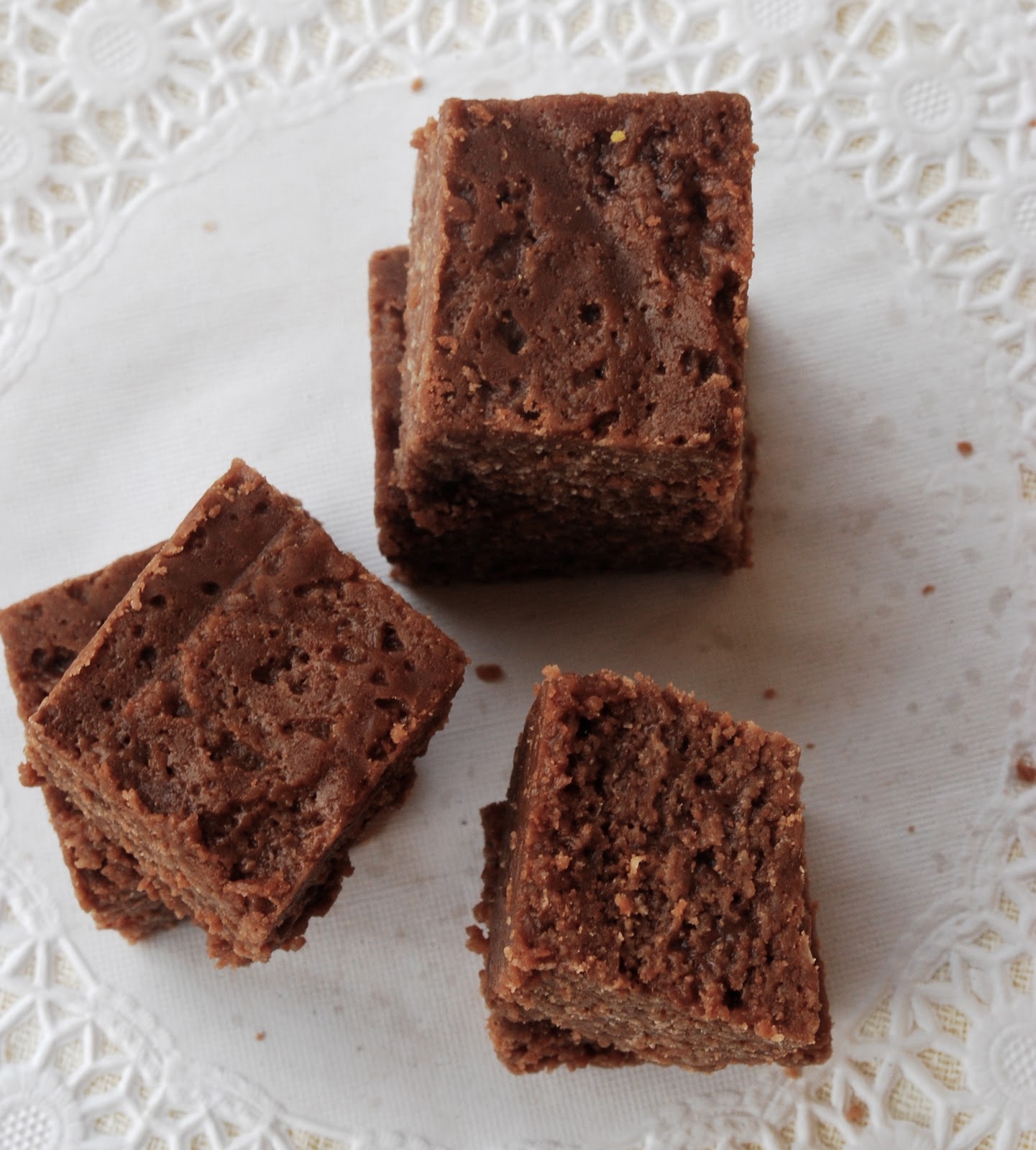
Choc-onut candy?


That chocolate and coconut go together wondrously is no secret.  All you gotta do is gnaw at (or chomp down, if you are like me) a Bounty bar or have at a lamington (squares of chocolate-coated sponge cake rolled in dessicated/flaked sweetened coconut) to realise that chocolate and coconut, when combined, is just divine.

So, on a particularly restless evening some weeks ago, I decided to try and determine if the choc-onut pairing would work also work in a favourite Malaysian dessert: coconut candy. Now I was aware that I was treading into dangerous waters because a true fan of the classic Malayisan (yes, I am claiming it to be Malaysian) coconut candy doesn't tolerate the bastardisation of the classic recipe.

As a rule, coconut candy must be either pink or green: the more garish the colours the better (see below). Also, the flavour should be pure coconut enhanced only with vanilla or rose essence.


So, seriously, I was a little nervous about messing with a classic. But curiosity always gets the better of me and so I pressed on.

I didn't have a recipe to go by and so, it took some experimenting to find the right amount of cocoa for the candy to be just right.

The first batch I made was weak. I was too stingy with the cocoa and as a result the chocolate flavour wasn't apparent at all and the colour was unappealing too; kinda sandy brown. Unacceptable!

I decided to be bold with the second batch and doubled the amount of cocoa I used. It worked. The taste of chocolate was very apparent and the candy looked like a brownie. Well, kinda.


The verdict? I loved the choc-onut candy as did many of my friends whom I made sample it. Would I try it again? Yeah! Would they try it again? Well, yes but only if I also serve them the original.

"It's lovely but I will always feel a little unfulfilled unless I have a garishly pink or green piece along with this one," was the consensus.

Choc-onut candy
3 cups grated coconut
450g castor sugar
170g evaporated milk
40g butter
1/4 cup cocoa
pinch of salt
1 tsp vanilla extract

Grease a small baking tray with butter.

Place the coconut, sugar, salt and milk in a wok over low heat and stir until the sugar dissolves. Add the butter and then the cocoa. Stir to incorporate both ingredients and then keep stirring  as the mixture thickens so that the bottom doesn't get burnt.

The tricky [art about candy is knowing when to take it off the heat. Take it off too early and your candy will be damp and maybe even a little soggy. Leave it on too long and the candy crumbles. The secret is to watch closely and remove it once the candy starts to stick together and when you stir it with a wooden spoon, it comes together in a ball. Well, sort off. It will be a little wettish still but don't fret, it will harden as it sets.

When the texture is right, remove the candy from the heat onto the greased tray. Using a sheet of foil, press it into a flat layer about 1 inch thick. Compress it well and level the top with a bowl or the palm of your hand.

Leave it to set for an hour or longer. If you want, you may serrate the block of candy by gently running a knife through the wettish layer (so it will be easier to break up or cut up later) but this isn't necessary. 


Friday, August 5, 2011

Cocktail Scones


I miss being younger (for I am still young, dammit). I used be able to enjoy a half-dozen cocktails and still be able to sound coherent, walk a straight line and wake up the next morning without a hangover. 
I even used to -- occasionally of course -- have a mid-afternoon cocktail (yes, on a work day) and still be able to go back to work with a clear-ish head.

Oh how I miss those days. 

These days, a single glass of Amarula (on the rocks, mind you. And mixed with milk) will having me sprawled on the couch, laughing at nothing in particular.  

If you are thinking, "wimp", I don't blame you. 


So, these days I take my alcohol in my food. 

Don't feel bad for me, it's not quite so sad. In fact it's pretty awesome and these rum-laced scones are proof of that. Now the 2 tbsp of rum will not make anyone drunk. But the rum sure gives these scones flavour and, I don't know if I am imagining it, they did put a little pep in my step.

Imagine this: rum (Captain Morgan, of course), coconut and pineapple. Does that sound like a vacation or what?

Told you not to feel sorry for me -- I'm having a party in my mouth and tummy. 


Party-in-your-mouth Scones

2.5 cups plain flour
1 tbsp baking powder
85gm unsalted butter, cold and cut in 1cm cubes
1/3 cup sugar
1/2 tsp salt
1 cup chopped pineapple (I used canned pineapple)
1/3 cup greek yoghurt
2 tbsp rum

Preheat the oven to 200C. 

Whisk together the flour, baking powder, sugar and salt. Add the cold butter and using your fingertips mix it into the flour till the mixture resembles coarse breadcrumbs. You can also use a mixer (with the paddle attachment) on low speed.

Add the pineapple and gently stir into the dough. Add the yoghurt and the rum and mix them in gently.
the dough should be sticky but you can add about 1/3 cup more flour if it is too wet.

Transfer the dough onto a well floured surface and shape it into a rectangle with your hands. Don't handle it too much. Divide and cut the rectangle into eight squares and transfer onto a lined baking sheet. 

Bake for 15 mins or until lightly golden on top. 


Sunday, June 12, 2011

A taste of Sri Lanka: Pol Sambal


I just came back from an eight-day holiday in Sri Lanka, the country from which my grandparents came. I didn't make it to Jaffna, the capital city of the Northern Peninsular where they were born and raised though.  To go to Jaffna, you need special permission from the Sri Lankan Defence Ministry. As my maiden trip to the country was a short one — a vacation rather than a homecoming — I decided to keep my visit to Jaffna for another time... soon. This time around I just wanted to see the beautiful country that friends and relatives who have been there told me about.  I wanted to visit the beautiful beaches and walk the scenic hillsides. I wanted to taste the food that I assumed would be somewhat similar to the fare I grew up with.  I wanted to shop. I wanted to be a carefree tourist. I didn't expect to be sentimental about being in the country of my grandparents but I was. It was easy to fall in love with the country: the lovely vistas and even lovelier people were all I needed to feel completely at home. It was strange but it was a nice kind of strange. 

Now, on to the food. I've eaten Sri Lankan food all my life. Food cooked by my grandmothers, aunts and of course my mum. I love the Sri Lankan food I grew up which is very similar to Indian cuisine. The food I tasted on my holiday was a little different though. I told this to an aunt upon my return and she said the food in Jaffna would have tasted more like home. Ah. Next time then. This time, I discovered new flavours and dishes. 

Many say Sri Lankan food is more fiery than Indian cuisine. While the spices that are used are the same (more or less), there are small but significant differences. For example,  Sri Lankan curries use roasted curry and chilli powders as opposed to the raw powders used in most Indian curries. Big difference? Yes, actually. I bought back a packet of roasted curry powder and cooked a curry for lunch today and discovered the difference: the roasted spice powders add a smokiness to the curries which goes well with the other main ingredient in Sri Lankan food I wish to highlight: coconut.

Coconut is a mainstay in Sri Lankan cuisine. Many Sri Lankan curries are thick with coconut gravy and vegetables are often cooked with either grated coconut or coconut cream. While the curries which I tasted and saw in Sri Lanka resembled the ones I grew up on, they were obviously much richer and creamier than what I was used to. My mother used coconut cream/milk sparingly for health reasons therefore our curries were somewhat thinner but no less tasty.

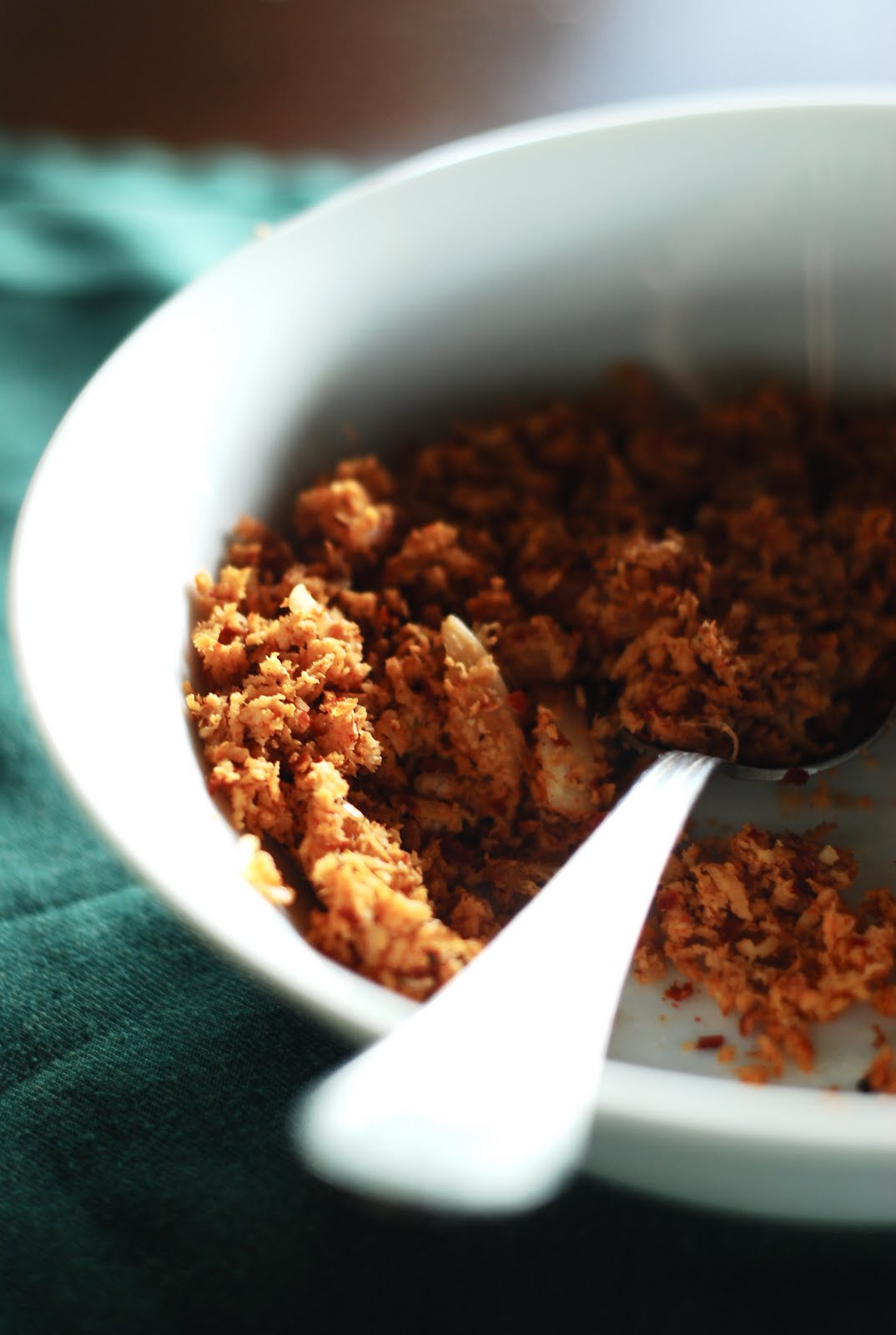
Apart from curries and vegetables, coconut is also used in making Pol Sambol (coconut sambol) — a popular condiment eaten with rice, string hoppers, bread ... basically anything in Sri Lanka. I got my first taste of Pol Sambal on my first morning in Sri Lanka. On the breakfast buffet, along with the string hoppers and sothi, Sri Lankan flat bread and fish curry and coconut rice cakes and lentil curry was this  fiery red dish that looked like chutney, only drier. I asked the waiter what it was and he explained that it was a coconut sambol made with fresh grated coconut, onions, chilli powder and lime. 

I don't usually eat breakfast but I couldn't resist serving myself some of the sambol. Just the sambol. It was fantastic. Spicy and a little tangy. I was hooked. 

The Pol Sambal on the breakfast buffet at the Kasappa Lions Rock resort
in Dambulla, Sri Lanka.

I was happy to note that the Pol Sambal is a popular condiment and was available at almost every buffet meal in Sri Lanka. Yay. I was determined to learn to make this dish and managed to get the recipe for it from Dillan, our friendly waiter at the Kasappa Lions Rock resort in Dambulla, Sri Lanka. 

The ingredients, according to Dillan, are grated coconut, green chillies, tomatoes, red onions, chilli powder, lime juice, salt and pepper. He didn't give me the exact measurements but that was fine as the taste of the smabol is ingrained in me now and I think I should be able to recreate it. 

I later learnt that some add crushed Maldivian fish (a popular ingredient in many Sri Lankan chilli pastes) in the Sambol but the vegetarian version without the fish is just as tasty, I felt. 

So in love with the humble Pol Sambol am I that the first thing I made when I came back from my holiday today was ... yup, you guessed right: Pol Sambol. I surfed the Net for some recipes just to make sure Dillan didn't accidentally leave out an ingredient or to — he didn't — and then got down to making the dish. 

Success! My Pol Sambol turned out pretty well.
Here's what you need:

Pol Sambol (coconut sambol)
1 coconut, grated
1-2 green chillis, diced extremely fine
1 medium tomato, chopped extremely fine
1 pip garlic, chopped extremely fine
1-11/2 tbsp roasted chilli powder
1 small lime, juiced
salt and pepper


Here's what you do:

Mix all the ingredients together with a spoon! That's it. 


Here's how you eat it:

The first thing I did with my Sambol was sandwich it in a slice of bread: yummmm.

I also served it to R, along with his rice and curry for dinner. I wasn't sure if he'd like it but I tried anyhow. He loved it. 

This was great news because this meant Pol Sambol will now be a fixture in my home.

Good with bread, rice, string hoppers, dosai ... or even on its own.
Note: Variations to the recipe include the addition of curry leaves, chilli oil (just a couple of drops) and  little curry powder. You can also omit the tomatoes and, if you like, dry fry the sambal for a couple of minutes before eating it. 


Monday, March 28, 2011

Flower power


Ain't that a pretty flower. It ain't real, in case you're wondering. I nicked it from work (no, work isn't all roses but this came with a festive hamper) for no reason other than because it looked so pretty. Pretty flowers make me smile.

Which is what led me to recently buy a silicon mould in the shape of a rose. Not one, two. I had no plans for the moulds but I had to buy them cause they looked so pretty.


A sucker, I am.

So anyway, I had these moulds and I had to use it so that I could have a pretty flower cake. I decided on a coconut-ginger cake. Two mould's weren't enough for the batter, so I made six muffins as well, frosted of course.

I love coconut cakes. They're moist and almost creamy and they taste, err, coconutty. In fact, I love almost anything coconut.

Candy, sweets, ice cream, bread .... and of course, the coconut liqueur, Malibu too.

Now, the first coconut cake I ever wanted to try was Ina Garten's gorgeous six-layer coconut cake with a delicious frosting and coconut shavings atop that. It's visually stunning and I'm quite sure a treat to devour. But, because my goal here was to make use of my pretty moulds, I settled on a plain but rich coconut cake that didn't need any frosting. The crystallised ginger added some chewiness to the cake but you can add mixed fruits too if you like.


See the three flowers all sitting pretty?

The flower cake needed no frosting but I decided to frost the muffins with coconut-flavoured cream cheese topping. Yum. Yum. Yum. 


I was going to bring these to work so I thought that I would leave some of the muffins unfrosted for the diet conscious folks at work. I got a shelling from my colleagues who, I hadn't realised earlier, were coconut lovers too. Mostly, they were dessert fiends who didn't mind the extra calories from the topping.

I bet they'll love Ina Garten's six-layer monstrosity.


So anyway, here's the recipe for my Coconut-Ginger Cake

250g unsalted butter, at room temperature
11/3 cups castor sugar
4 eggs
11/4 cups self-raising flour, sifted
11/3 cups plain flour, sifted
2/3 cup coconut milk 
1 cup crystallised ginger cubes

For the frosting
180g unsalted butter
2 cups icing sugar
2 tbsp milk

Start with the cake. Preheat the oven to 160C. Grease the moulds and set aside. Using an electric mixer, beat butter and sugar till light and fluffy. Beat in the eggs, one at a time, until combined well. Stir in the sifted flours and coconut milk until well incorporated. 

Stir in the ginger.

Spoon the batter into the moulds and bake for about 35 to 40 mins till a tester comes out clean. 

Let the cake cool while you make the icing.

Beat the butter until light and fluffy, add the sugar (sifted) and milk and mix until pale and creamy.

Ice the muffins when they've completely cooled.

Wallop!  

Related Posts with Thumbnails